

Table of Contents
- Why Choose Greece for Higher Studies in 2026?
- Can You Study in Greece Without IELTS or PTE?
- Eligibility: Can You Apply With 55% Marks?
- Top Universities to Study in Greece
- Cost of Studying in Greece
- Greece Student Visa Process for Indian Students
- Pay Only After Visa Approval
- 1-Year Job Search Visa After Graduation
- Documents Required for Greece Student Visa
- Life as a Student in Greece
- Final Thoughts
- Frequently Asked Questions
Greece is quickly becoming one of the most talked-about study destinations for Indian students. It is part of Europe, it follows the European education system, and it gives you a chance to live and study in a safe, low-cost country with a rich history. If you have been searching for an affordable European country where you can study without spending lakhs of rupees, this guide will help you understand everything about studying in Greece in 2026.
In this blog, we will cover Greek universities, courses, fees, visa process, admission without IELTS or PTE, eligibility with 55% marks, and the 1-year job search visa after graduation. Let’s get started.
Why Choose Greece for Higher Studies in 2026?
Greece is a member of the European Union, which means your degree is recognised across Europe and in most parts of the world. Here are the main reasons Indian students are choosing Greece:
- Low tuition fees – Public universities in Greece offer very affordable fees, and Greek-taught programs at public universities are free for many students, while English-taught programs usually range between €1,000 and €10,000 per year.
- Low cost of living – Cities like Thessaloniki and Patras are much cheaper than Athens, and overall living costs in Greece are lower than in the UK, Germany, or France.
- English-taught programs – Many bachelor's and master's programs are taught fully in English, especially at the postgraduate level.
- Part-time work allowed – Students can work part-time during their studies and full-time during official holidays.
- 1-year post-study visa – Non-EU graduates can apply for a job search extension after finishing their degree.
- Safe and welcoming country – Greece has a growing international student community, especially in Athens and Thessaloniki.
- Degree recognition – Since Greece is part of the European Higher Education Area (EHEA), your degree is recognised across Europe and globally.
If you are also exploring other affordable European countries, our team at Unitrack Overseas can guide you through options like studying in Europe, so you can compare and choose the destination that fits your budget and goals.
Can You Study in Greece Without IELTS or PTE?
Yes, this is one of the biggest reasons Indian students prefer Greece. If you are not confident about IELTS or PTE, or you simply want to skip the stress and cost of these exams, many Greek universities accept alternative proof of English proficiency, such as:
- A Medium of Instruction (MOI) certificate from your school or college confirming that you studied in English.
- Good marks in English in your Class 12 or bachelor's degree.
- A short language interview conducted by the university.
- Prior education in an English-medium school or college.
It is important to understand that an IELTS waiver at the admission stage does not always mean a waiver at the visa stage, so always double-check both the university and visa requirements before applying. Many Greek universities offering English-taught programs are open to this kind of flexibility, especially for students coming from English-medium boards like CBSE, ICSE, or state boards.
Explore More No-IELTS Destinations
If you want to explore more countries where you can study without IELTS or PTE, take a look at our detailed guide on study abroad options without IELTS, which covers Greece along with other popular destinations.
Eligibility: Can You Apply With 55% Marks?
A common worry among Indian students is whether average marks will stop them from studying abroad. The good news is that many universities in Greece accept students with 55% marks in their academics for both bachelor’s and master’s programs. This makes Greece a realistic option for students who may not meet the higher percentage cut-offs required by countries like the UK or Canada.
General eligibility for Greece looks like this:
For Bachelor's Programs:
- Completion of Class 12 with an average of around 55% or above.
- Basic proof of English proficiency (MOI, English marks, or interview).
- Valid passport and required application documents.
For Master's Programs:
- A relevant bachelor's degree with around 55% or above.
- Academic transcripts from your bachelor's program.
- Statement of purpose and, in some cases, letters of recommendation.
Since exact requirements can vary from one university to another, it is always best to get your profile evaluated before applying. Our counselors can guide you on this as part of our visa assistance for higher studies abroad, so you apply to universities where your marks are actually accepted.
Top Universities to Study in Greece
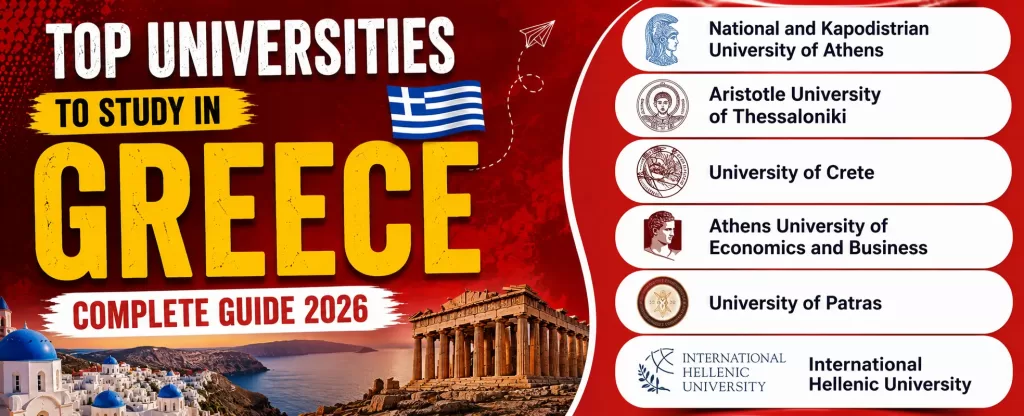
Greece has several public universities that are popular among international students. Some of the well-known names include:
- National and Kapodistrian University of Athens
- Aristotle University of Thessaloniki
- University of Crete
- Athens University of Economics and Business
- University of Patras
- International Hellenic University
These universities offer a mix of Greek-taught and English-taught programs across fields like business, engineering, computer science, tourism management, and social sciences.
Cost of Studying in Greece
One of the biggest advantages of Greece is affordability. Here is a rough idea of what you can expect:
Tuition Fees:
- Greek-taught public university programs: often free or very low cost for eligible students.
- English-taught programs: approximately €1,000 to €10,000 per year, depending on the university and course.
Living Costs:
- Athens: slightly higher cost of living due to it being the capital city.
- Thessaloniki and Patras: more budget-friendly for students.
On average, students should plan for a realistic monthly budget, since actual living costs are usually higher than the minimum amount shown for visa purposes.
It is a good idea to plan your finances for the full first year, including accommodation, food, transport, and health insurance, rather than only budgeting for the visa requirement.
Greece Student Visa Process for Indian Students
If you are planning to study in Greece for more than 90 days, you will need a National Long-Stay Visa, known as the Type D visa, since Greece is a Schengen country.
Basic Visa Requirements:
- Confirmed offer of admission from a recognised Greek university.
- Proof of financial support (bank statements or sponsor documents).
- Valid passport with sufficient validity.
- Travel and health insurance.
- Apostilled academic documents (degree and transcripts must be apostilled by the Ministry of External Affairs in India before applying).
- Proof of accommodation in Greece.
Visa Processing Time: The Type D student visa usually takes a few weeks to process, though timelines can vary depending on the embassy and the completeness of your documents. It is best to apply well in advance of your intake to avoid last-minute stress.
After you land in Greece, you will also need to apply for a residence permit, which allows you to legally stay and study for the duration of your program.
Pay Only After Visa Approval
We understand that arranging money before your visa is confirmed can be stressful for many families. That’s why, at Unitrack Overseas, we work on a simple and transparent model where you can proceed with our guidance and pay our service charges after your visa gets approved. This way, you don’t have to worry about upfront payment risk while your visa application is still in process. Our team supports you from choosing the right university to preparing your documents, so you can focus on your studies instead of paperwork.
1-Year Job Search Visa After Graduation
One of the biggest attractions of studying in Greece is the opportunity to stay back and look for work after completing your degree. Non-EU students, including Indian students, do not get an automatic post-study work visa, but they can apply for a job search extension of up to 1 year after graduation to look for employment or start a business in Greece.
To convert this into an actual work permit, you will need to switch from your student residence permit to a work-linked residence permit once you secure a job offer. This 1-year window gives graduates enough time to explore the Greek job market, attend interviews, and build local work experience, which can be valuable for your long-term career in Europe.
Keep in mind that if you plan to apply for long-term residency (PR) in Greece later, your student years are usually counted at a reduced value compared to work years, so you will still need a few years of employment after your studies to become eligible for PR.
Documents Required for Greece Student Visa
Here is a general checklist of documents you will need:
- Valid passport (with at least one year of validity)
- University admission/offer letter
- Academic transcripts and certificates (apostilled)
- Proof of English proficiency (if required)
- Proof of financial support
- Health and travel insurance
- Passport-size photographs
- Visa application form
- Proof of accommodation in Greece
- Statement of purpose (for some programs)
Since visa rules can be updated from time to time, it’s a good idea to confirm the latest document checklist with the Greek Embassy or with an experienced visa consultant before you apply.
Life as a Student in Greece
Studying in Greece is not just about academics. It’s also about experiencing Greek culture, history, and lifestyle. From ancient landmarks in Athens to the coastal charm of Thessaloniki, Greece offers a unique blend of history and modern student life. The country has a growing international student community, so you will find plenty of fellow Indian and international students to connect with.
Public transport is affordable, food is reasonably priced if you cook at home, and the overall pace of life is relaxed compared to bigger European cities. Learning a few basic Greek phrases can also make your daily life easier, even though most university programs and city life are manageable in English.

Final Thoughts
Greece is turning into a smart and affordable choice for Indian students who want a European education without the pressure of high tuition fees or strict English test requirements. With flexible admission criteria, options to study without IELTS or PTE, acceptance of 55% marks for many programs, and a 1-year job search visa after graduation, Greece offers a realistic and budget-friendly path into Europe.
If you are ready to start your journey, our team at Unitrack Overseas can guide you through university selection, documentation, and the entire visa process, with the added benefit of paying only after your visa is approved.
Frequently Asked Questions (FAQs)
Written by Unitrack Overseas
Study and visitor visa consultants in Chandigarh & Ambala City, helping students plan admissions and visas since 2008.
Planning to Study in Europe?
Talk to our counselors for a free profile evaluation and find out which European country and university fits your marks, budget, and goals.