
Planning to study in Australia? Before you can enrol in any full-time course, you’ll need a valid Student Visa – the Subclass 500. This guide walks you through everything that matters for the Australia student visa 2026: who qualifies, what documents you need, how the application works, and what mistakes trip up even well-prepared applicants.
Australia consistently ranks among the top destinations for Indian students, and it’s not hard to see why – world-class universities, a globally recognised degree, and real chances of working after completion. The visa process just takes effort: knowing all requirements beforehand will spare you a lot of headache later. If you’d like personalised help, our study in Australia consultants can guide you end to end.
Australia Student Visa 2026 - At a Glance
Quick Summary
| Question | Quick Answer |
|---|---|
| Which visa do I need to study in Australia? | Student Visa (Subclass 500) |
| Who needs to apply? | International students enrolled in an approved Australian course |
| Is IELTS compulsory? | It depends on your institution and profile – but most students need it |
| Is health insurance required? | Yes – OSHC is mandatory for the entire duration of your stay |
| Can I work while studying? | Yes, up to 48 hours per fortnight during term time |
| What is the Genuine Student Requirement? | You need to show that studying is your main reason for going to Australia |
What Is the Australia Student Visa (Subclass 500)?
The Subclass 500 is the single student visa for all course types in Australia. It replaced the older stream-based system (subclasses 570-576) and now covers everything from bachelor’s degrees to diplomas to vocational qualifications.
If you have been accepted into a full-time course at a CRICOS-registered institution, this is the visa you need – no exceptions.
With a Subclass 500 visa, you can:
- Study full-time at your enrolled institution
- Work up to 48 hours per fortnight while your course is running, and unlimited hours during scheduled breaks
- Bring eligible family members to Australia as secondary visa holders
- Travel in and out of Australia throughout the visa's validity
Eligibility Criteria for the Australia Student Visa 2026
You need to satisfy all of the following requirements. If you’re unsure how your profile stacks up, getting it assessed by an experienced consultant before applying is worth doing.
Enrolled in a Registered Course
Your institution and course must appear on the CRICOS register. Check the official Study Australia website before applying – not every institution or every course is registered.
English Language Proficiency
IELTS, PTE Academic, and TOEFL iBT are all accepted. Most universities expect an IELTS overall of at least 6.0 to 6.5, though this varies by course and institution. Our IELTS preparation programs can help you reach the required band.
Financial Ability
You have to satisfy the department that you will not be a financial burden on others while undertaking your course of study. The Home Affairs website states approximate benchmarks – always check current figures there.
Health and Character
Most applicants need to meet basic health and character standards. Some will be required to complete a medical examination, and any criminal history must be declared.
Genuine Student Requirement
This is where many applications fall short. You need to convince the visa officer that your real purpose in going to Australia is to study. There’s a dedicated section below that covers how to handle this properly.
Documents Required for the Australia Student Visa
Getting your documents in order early is one of the best things you can do for your application. Here is what you will need:
- Valid passport - with at least six months validity beyond your intended stay in Australia
- Offer letter and Confirmation of Enrolment (CoE) - issued after you accept your university offer
- Academic transcripts and certificates - Class 10, Class 12, and any completed degrees
- English language test scores - IELTS, PTE, or TOEFL results
- Financial documents - bank statements, fixed deposits, education loan approval, or sponsor income proof
- Overseas Student Health Cover (OSHC) - mandatory, purchased from an approved provider
- Genuine Student statement - explaining your study plans and intentions
- Additional documents as needed - gap explanation, visa refusal disclosures, sponsor proof
| Requirement | What You Need | Why It Matters |
|---|---|---|
| Course Enrolment | Confirmation of Enrolment (CoE) from a CRICOS-registered institution | Mandatory – no CoE, no visa application |
| Genuine Student Requirement | Clear study goals and genuine intent to study in Australia | One of the main factors assessed by the visa officer |
| English Language | IELTS, PTE, TOEFL, or an accepted equivalent | Shows you’re academically ready for study in English |
| Financial Capacity | Proof of funds for tuition, living costs, and travel | Confirms you can support yourself in Australia |
| Health Insurance (OSHC) | Overseas Student Health Cover from an approved provider | Mandatory from visa grant through course completion |
| Health & Character | Medical exam and police clearance if required | Standard requirement from Department of Home Affairs |
How to Apply for the Australia Student Visa: Step by Step
Follow these six steps to move from course selection to visa decision.
Step 1 - Choose Your Course and University
Start by researching CRICOS-registered institutions that match your academic background and what you want to do after graduation. Compare entry requirements, fee structure and scholarship opportunities before deciding. Your selected course will be the core of your Genuine Student statement.
Step 2 - Get Your Offer Letter and CoE
When accepted, the university will send you an offer letter. After you accept it and pay any required deposit, they will issue the Confirmation of Enrolment (CoE), which must be included with your visa application.
Step 3 - Prepare Your Documents
Pull together every document from the checklist above. Make sure academic certificates are attested if required. Write your Genuine Student statement with care – it is not a box-ticking exercise.
Step 4 - Submit Your Application Online
Your application is submitted via the ImmiAccount facility on the Australian Department of Home Affairs website. Complete the online form, upload documentation, pay the visa application fee (currently AUD 710 for most applications), and lodge.
Step 5 - Complete Biometrics and Medical Tests if Required
After submitting, you may be asked to attend a health examination and provide biometric data. Both are done in India at approved centres. Respond to any requests quickly – delays here slow down the whole process.
Step 6 - Wait for a Decision
Processing generally takes 4 to 8 weeks. Keep an eye on your ImmiAccount and reply promptly if the department asks for anything further.
The Genuine Student Requirement Explained
The Genuine Student Requirement is the visa officer’s way of checking that you are actually going to Australia to study – and not for some other purpose. You demonstrate this mainly through a personal statement, and it has to be convincing.
What Makes a Strong Statement
- Explain clearly why you chose this specific course and institution
- Show how the course connects to your past studies and career goals
- Point to ties back home - family, property, career plans - that show genuine reason to return
- Address any gaps in your education openly and honestly
What to Avoid
- A vague, generic statement that could have been written by anyone
- Choosing a course with no obvious link to your previous study or work
- Information that contradicts what appears elsewhere in your application
- Ignoring a significant study gap - if it is there, explain it
English Language Requirements
Most Australian student visa applicants need to show English proficiency. IELTS Academic, PTE Academic, and TOEFL iBT are the three main options. Check your university’s requirements for the specific course you are applying to – they can differ.
As a rough guide for Indian students in 2026:
- IELTS: Overall band 6.0 to 6.5 (with no individual band typically below 5.5 or 6.0, depending on the institution)
- PTE Academic: Generally 58 to 65 overall
- TOEFL iBT: Typically 72 to 90, depending on the course
If your score is not where it needs to be, work with a qualified coach and give yourself enough time to improve before the application deadline. Pre-sessional English programmes exist, but improving your score first is nearly always the better path. Explore our IELTS coaching for structured preparation.
| Feature | IELTS | PTE Academic | TOEFL iBT |
|---|---|---|---|
| Accepted for Student Visa | Yes | Yes | Yes |
| Test Format | Paper or Computer | Computer-Based | Internet-Based |
| Speaking Section | Face-to-Face with Examiner | Recorded on Computer | Recorded on Computer |
| Results Timeline | Usually 3-13 days | Often within 48 hours | Around 4-8 days |
| Popularity Among Indian Students | Very High | High | Moderate |
| Best Suited For | Traditional test-takers | Those needing faster results | Students familiar with American English |
Financial Requirements
The visa requires you to show you can financially support yourself throughout your studies. As a general guide for 2026:
- Living expenses: approximately AUD 29,710 per year for the student
- Tuition fees for at least the first year of your course
- Travel costs to and from Australia
Always verify the current figures on the official Department of Home Affairs website – these amounts are updated periodically.
Documents that are typically accepted include:
- Bank statements from the last 3 to 6 months showing a consistent balance
- Fixed deposit certificates
- An education loan sanction letter from a recognised bank
- Your sponsor's income proof - salary slips, income tax returns, or business ownership documents
A few things that commonly cause problems for Indian students:
- Large deposits appearing in the account just before the application - this raises questions about source of funds
- Bank statements that are outdated or show inconsistent figures
- No explanation for where the money in the account came from
Health Insurance, Medical Checks, and Biometrics
Overseas Student Health Cover (OSHC)
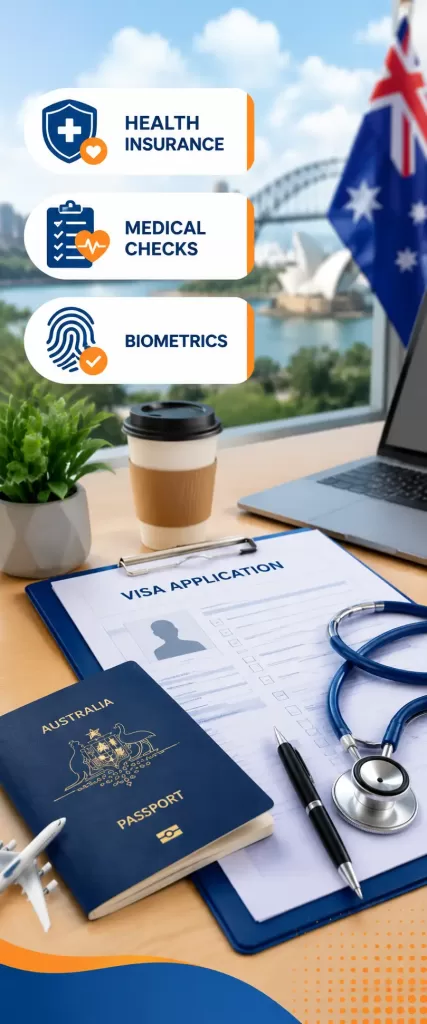
OSHC is not optional – it is a compulsory requirement for all international students in Australia. You must buy OSHC before your visa is granted, and it must cover your entire stay. Eligible providers in 2026 include Medibank, Bupa, nib, AHM, and CBHS Corporate Health.
Medical Examination
Not all students require a medical examination, but those applying for a course over 12 months are generally expected to do so. This can be carried out at approved clinics in major Indian cities such as Delhi, Mumbai, Chandigarh, and Chennai.
Biometrics
You may be asked to provide fingerprints and a photo at a Visa Application Centre in India. If required, you’ll be notified through your ImmiAccount.
Why Australia Student Visa Applications Get Refused
Most refusals come down to the same handful of issues. Understanding them helps you steer clear of them. The good news: nearly all of these reasons are preventable through due diligence, and it is very unlikely your application will be rejected if you get expert advice.
| What Helps Your Application | What Gets Applications Refused |
|---|---|
| A specific, well-argued Genuine Student statement | A vague or copied study intent statement |
| Clear, realistic career objectives | No clear reason for the chosen course |
| Complete documentation submitted together | Missing or incomplete documents |
| Verifiable and consistent financial evidence | Insufficient or unexplained financial proof |
| A coherent academic history | Unexplained gaps in education |
| Valid English test scores meeting course requirements | Scores below the required threshold |
| Information consistent throughout the application | Contradictions between documents or statements |
Applying Yourself vs Working with a Consultant
Some students prefer to handle the application themselves. Others – particularly first-time applicants – find the process easier with professional support. Here’s an honest comparison:
| Factor | Self-Application | With a Professional Consultant |
|---|---|---|
| Course Selection | You research independently | Guided by someone who knows the Australian system |
| Document Review | Based on your own checklist | Checked against current requirements |
| Genuine Student Statement | Written without specialist input | Guided by someone who knows what works |
| Error Risk | Higher – easy to miss something | Lower – checked before submission |
| University Applications | Managed separately across institutions | Coordinated and streamlined |
| Post-submission Follow-up | You handle it yourself | Ongoing support through the decision |
| Best For | Applicants with prior visa experience | First-time applicants or complex cases |
The decision depends on your confidence with the process and how straightforward your situation is. For students from North India applying for the first time, working with experienced study visa consultants in Chandigarh typically makes a practical difference.
Study Pathway Options for Indian Students
Not sure which level of study suits your goals? Here’s a quick overview:
| Study Level | Typical Duration | Popularity Among Indian Students | Where It Can Lead |
|---|---|---|---|
| Diploma | 1-2 years | High | Often a pathway into a bachelor’s degree program |
| Bachelor’s Degree | 3-4 years | Very High | Graduate employment across most industries |
| Master’s Degree | 1.5-2 years | Very High | Skilled career advancement and specialist roles |
| PhD | 3-4 years | Moderate | Research, academia, and specialist fields |
| Vocational Education (VET) | 6 months-2 years | Growing | Industry-specific skills with strong employment outcomes |
Support for Students from Chandigarh, Ambala, and Surrounding Areas
Students from Punjab, Haryana, and the wider North India region have consistently been among Australia’s most active international student cohorts. If you are based in Chandigarh, Ambala, Mohali, Patiala, Karnal, Ludhiana, or nearby, there are real advantages to working with local consultants who understand the specific challenges students from this region face.
A study gap from board exams, a family-funded education with documents in a mix of languages, a first-generation applicant with no visa history – these are situations that come up regularly for North Indian students, and knowing how to handle them in the application makes a real difference.
Our team at Unitrack Overseas works with students across this region, from initial course selection right through to pre-departure briefings. In-person guidance, personalised document preparation, and end-to-end support – not a generic checklist.
Frequently Asked Questions
Final Thoughts
The Australia student visa 2026 isn’t really so difficult for Indians to secure if things are done correctly. Three areas distinguish an accepted application from a refused one: complete documentation, a tailored and credible Genuine Student statement, and financially verifiable evidence.
Though it may seem complicated at first, the process becomes manageable once broken down into sequential steps. Most refusals happen because applicants underestimated how closely documentation is checked, or submitted a statement of purpose that wasn’t specific enough to be credible. Thorough preparation and attention to the Genuine Student element are essential to securing your visa on the first attempt.
Talk to Our Australia Visa Experts
At Unitrack Overseas – overseas education consultants in Chandigarh – we help students from across North India put together stronger, more complete Australia student visa applications. From picking the right course to preparing your documents to submitting the application, our team is with you at every stage.
Walk in, call us, or reach out online – we are here to help you study in Australia with confidence.